How to select the correct stainless steel hose for an espresso machine
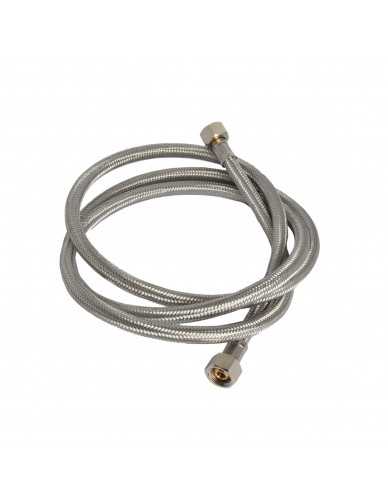
Flexible hoses can look almost identical while differing in length, thread configuration, sealing face or application. Use this selection order:
machine/application → OEM reference → overall length → connection 1 → connection 2 → straight or elbow fitting → sealing geometry → pressure/temperature rating → certification or special function
Start with the machine and hose application
First determine where the hose is used. Stainless steel braided hoses can be installed between the mains water connection and the machine, between a pump and another hydraulic component, or internally between components such as the pump and water inlet valve.
For a machine-specific hose, use the manufacturer, exact model and OEM reference whenever available. A hose with apparently identical dimensions may still have a different connection geometry or function.
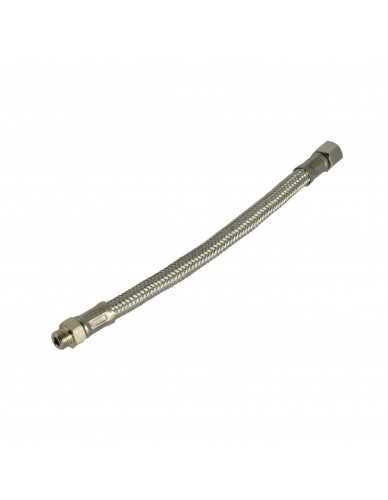
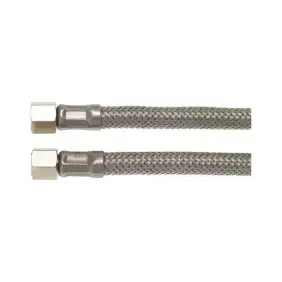
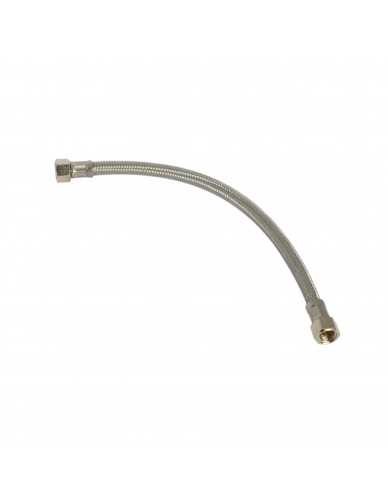
For example, the Rancilio Silvia 205 mm flexible hose uses a 1/8" BSP-G male connection on one side and a 1/8" BSP-G female connection on the other.
Check the overall hose length
The hose must be long enough to follow the original routing without being stretched, but excessive length can also create unnecessary loops or interfere with surrounding components.
Compare the original routing and the stated overall product length. On many hoses in this category, the published overall length includes the end fittings.
Do not force, sharply bend or twist a braided hose to compensate for an incorrect length or fitting orientation.
Identify both threaded connections separately
Each end of the hose must be checked independently. The assortment includes 1/8", 1/4" and 3/8" BSP-G connections in different male and female configurations.
For example:
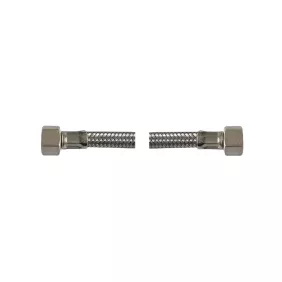
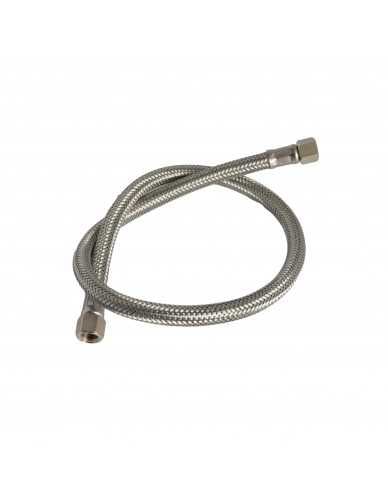
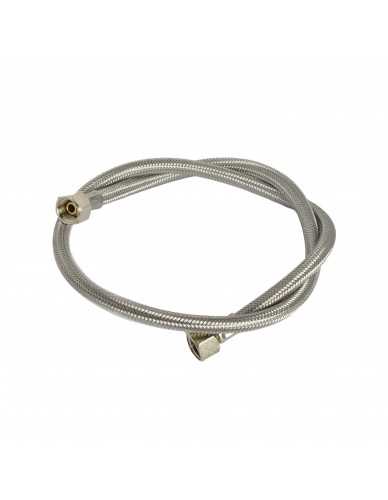
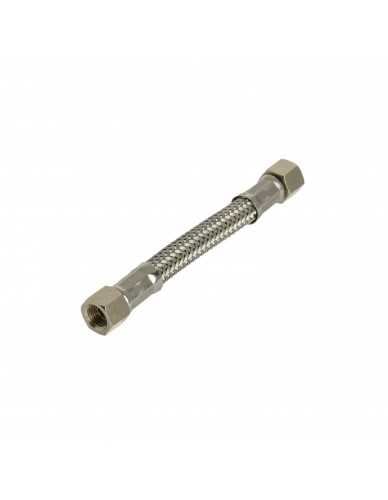
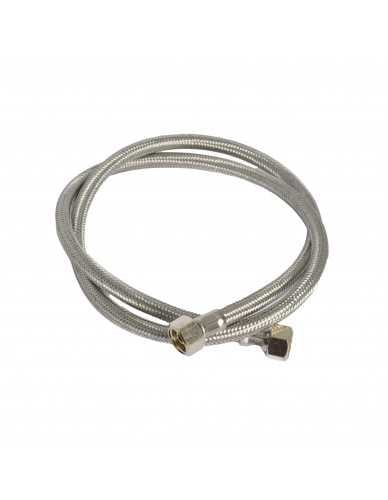
- 3/8" F × 3/8" F has female connections on both ends;
- 1/8" M × 1/8" F combines male and female threads;
- other machine-specific hoses can use different configurations on each side.
Male means an external thread; female means an internal thread. Two hoses with the same nominal BSP-G sizes are not interchangeable if the thread gender differs.
BSP-G size is a nominal thread size
BSP-G sizes such as 1/8", 1/4" and 3/8" are nominal pipe-thread sizes. The measured outside diameter of a male thread is therefore not equal to the stated inch size.
When identifying an unknown hose, compare the original fittings and mating components rather than selecting only from a measured thread diameter.
Straight fittings and 90° elbows
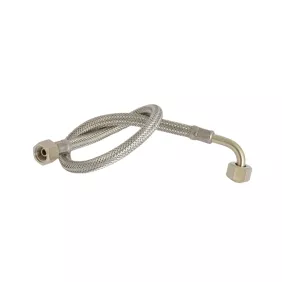
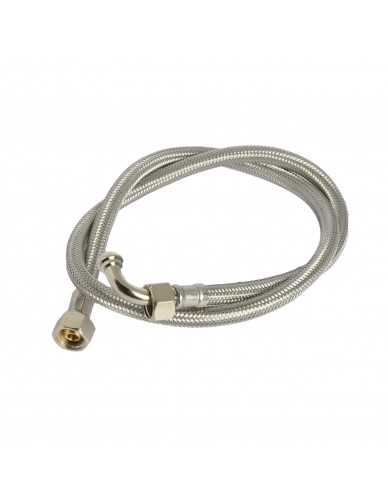
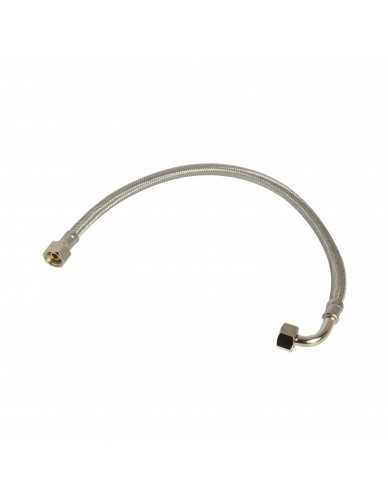
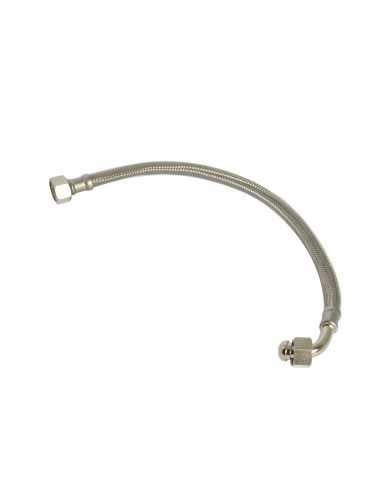
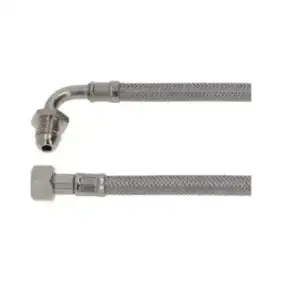
Some braided hoses have straight fittings on both ends, while others use a 90° elbow on one side. An elbow can be necessary where there is limited installation space or where the mating port requires the hose to change direction immediately.
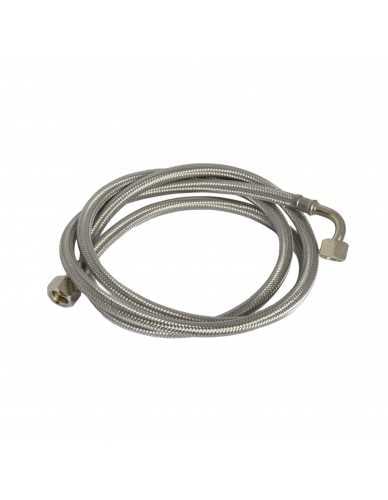
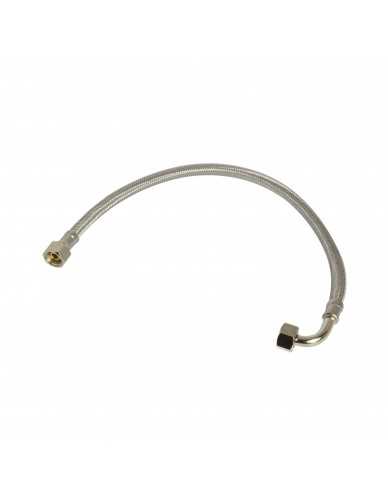
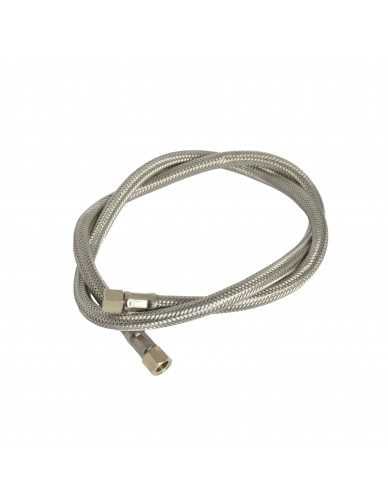
For example, the 2000 mm 3/8" female-female hose has a 90° connection on one end.
Do not replace an elbow fitting with a straight fitting simply because the thread size and hose length match. Check clearance, hose routing and the orientation of the original connection.
Check the sealing geometry
The thread does not always create the pressure seal by itself. Many flexible hoses use a shaped sealing surface such as a conical seat, while other connections may use a gasket, washer or flat sealing face.
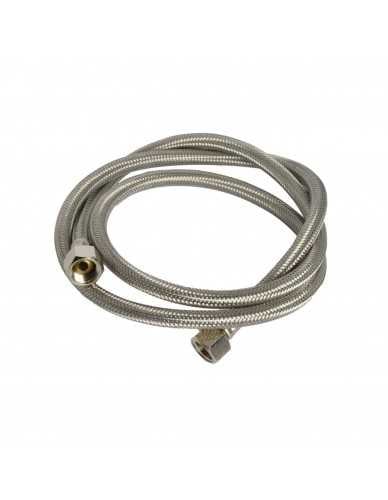
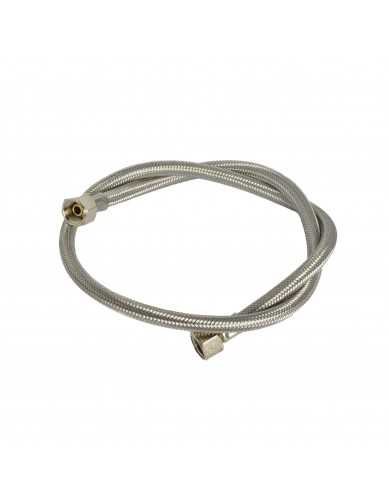
For example, the 1500 mm 3/8" F × 3/8" F hose is specified with conical sealing surfaces. In this type of connection, the seal is formed at the mating cone rather than with a separate flat gasket.
A fitting screwing into the port does not by itself confirm compatibility. The original sealing geometry must also match.
Do not automatically apply PTFE tape
BSP-G is a parallel pipe thread. Depending on the connection, sealing can take place at a cone, gasket, washer or machined sealing face rather than in the thread itself.
Do not automatically add PTFE tape or liquid thread sealant to every BSP-G hose fitting. Inspect the original connection and reproduce its intended sealing method.
Pressure and temperature ratings differ
Do not assume that every braided hose in this category has the same maximum pressure or temperature.
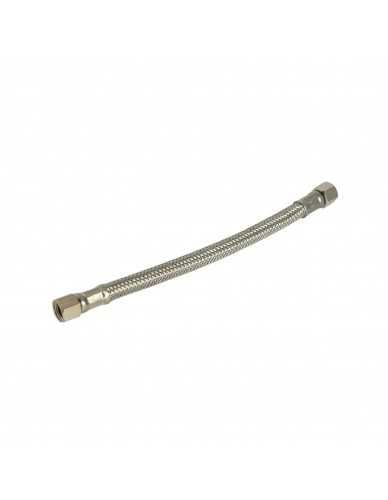
Many products are specified for operation up to 10 bar and 90°C, while other hoses have different ratings. For example, the 300 mm 1/8" female-female EPDM hose is specified for a maximum pressure of 20 bar and a maximum temperature of 90°C.
Always use the pressure and temperature specification from the individual product page and make sure it is suitable for the original machine application.
Stainless steel braid and internal hose material
The stainless steel braid is the external reinforcement of the hose. The fluid itself flows through an internal flexible hose, which can be made from materials such as EPDM depending on the product.
The outside appearance of two braided hoses therefore does not prove that their internal construction or operating specifications are the same.
NSF-certified hoses
Some hoses in this category are listed with NSF certification. This can be relevant for particular machines, markets or potable-water applications.
If the original installation requires a specific certification, confirm that certification on the individual replacement hose rather than assuming it applies to the entire category.
OEM-specific hoses and special functions
Some flexible hoses are more than a generic piece of tubing with two fittings. Machine-specific versions can include a particular fitting arrangement or an additional hydraulic function.
For example, the Rancilio 1800 mm water inlet hose is specified with a 3/8" female connection, a 90° male connection and an integrated non-return valve.
For these hoses, match the OEM reference, machine application, complete fitting geometry and any integrated function. Do not replace them with a generic hose based only on length and thread size.
Generic hoses and shared machine applications
A generic braided hose can be suitable for several espresso machine manufacturers when the dimensions, fittings, sealing geometry and operating specifications are identical.
For example, the 300 mm 1/8" female-female hose is listed for machines from several manufacturers. Shared applications are normal when the same technical hose specification is used.
Stainless steel braided hose or silicone hose?
A stainless steel braided hose and an unreinforced silicone hose are different part types.
Braided hoses are supplied with defined end fittings and are used for specific pressurised hydraulic connections. Silicone tubing is selected by dimensions such as inside and outside diameter and is used in different applications.
For flexible tubing without braided reinforcement and threaded end fittings, see silicone and Teflon hoses.
Connecting to fittings and water inlet components
If the problem is not the hose itself, inspect the components at both ends of the connection. Damaged sealing faces, incorrect adapters or leaking fittings can cause the same symptoms as a defective hose.
See espresso machine fittings for adapters, nipples and other threaded connections, or water inlet valve parts for components on the machine's filling circuit.
Installation checks
Before installation, compare the new hose with the original part and inspect both mating connections.
- confirm the overall length;
- check both thread sizes and genders;
- check straight or elbow orientation;
- identify the original sealing surfaces;
- make sure the hose follows its route without tension or sharp bends;
- keep the hose away from moving parts and damaging edges;
- check the pressure and temperature rating;
- verify OEM references or certifications where required.
After installation, inspect the complete hydraulic connection for leaks under normal operating conditions.
Final check before ordering
Verify:
machine/application → OEM reference → overall length → thread standard and size side 1 → male/female side 1 → thread standard and size side 2 → male/female side 2 → straight/elbow → sealing geometry → pressure/temperature → certification → special function
Do not select a stainless steel braided hose from length or thread size alone. Both end connections, sealing geometry and the intended machine application must match.