How to identify the correct espresso machine pressure gauge
A pressure gauge is not identified by one specification. Two gauges can have the same pressure range while using different body dimensions, mounting arrangements, threads or pressure connections. Start with the machine and OEM reference where possible, then verify the complete mechanical and hydraulic specification.
Use this sequence when comparing replacements:
machine manufacturer → exact model/version → OEM reference → measured circuit → pressure range → gauge dimensions → connection method → thread specification → sealing geometry → listed application
1. Start with the machine model and OEM reference
The machine manufacturer and exact model are normally the strongest starting points. Use espresso machine parts by brand and model to narrow the selection before comparing individual gauges.
Do not assume that one espresso machine brand uses the same gauge across its complete model range. Gauge type, pressure range, front dimensions and hydraulic connection can vary between models and production versions.
If an OEM reference is available from the original gauge, exploded view or parts manual, use it as an additional identifier. A compatible gauge can carry a different manufacturer or Brooks reference while corresponding to the same OEM application.
Boiler, pump and dual pressure gauges
First identify which pressure circuit the gauge measures.
Boiler pressure gauges
A boiler pressure gauge displays pressure in the steam-boiler circuit. These gauges commonly use a lower pressure scale than pump gauges, but the correct range must always be taken from the original machine specification or OEM reference.
Do not replace a boiler gauge simply because another gauge has a similar physical diameter. The scale, connection, body size and mounting arrangement must also match.
Pump pressure gauges
A pump pressure gauge displays pressure from the hydraulic circuit at the point where the manufacturer has connected the gauge. Pump gauges therefore normally use a substantially higher pressure range than boiler gauges.
Do not assume that the value displayed on the machine is necessarily pressure measured directly at the coffee puck or brewing group. The reading depends on the location of the pressure take-off within the hydraulic circuit.
For related pump components, see espresso machine pumps and motors.
Dual boiler and pump gauges
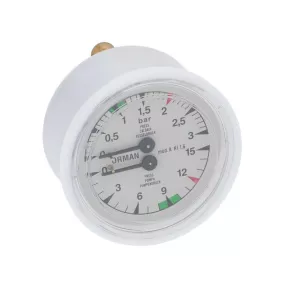
A dual pressure gauge combines two pressure indications in one housing: one for the boiler circuit and one for the pump circuit. Both pressure ranges must match the intended application.
For example, the 63 mm boiler/pump pressure gauge combines a 0–2.5 bar boiler scale with a 0–16 bar pump scale. It has a 63 mm body, 70 mm frame and male 1/8" BSP-G connections. Brooks reference: 49-187-L-1245411. It is listed for applications including Astoria, Grimac and Wega machines.
This illustrates why a dual gauge should be selected as two pressure circuits within one instrument rather than simply by one generic “pressure range” value.
Pressure range is only one selection criterion
Pressure ranges such as 0–2.5 bar, 0–3 bar, 0–15 bar or 0–16 bar describe the scale of the instrument. They do not define the complete gauge.
Two gauges with a 0–16 bar range can differ in body diameter, bezel size, thread, connection position, capillary configuration, dial design or machine application.
A pressure range should therefore be used only after the measured circuit and machine application have been identified.
Gauge body diameter and bezel size are different measurements
For round gauges, distinguish between the diameter of the gauge body behind the machine panel and the diameter of the visible bezel or frame at the front.
The body must fit the available opening and space inside the machine, while the bezel must suit the front-panel arrangement. These dimensions are not necessarily equal.
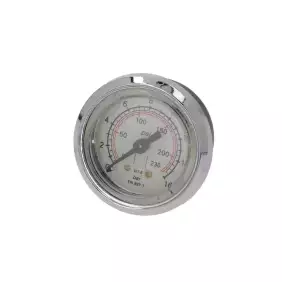
For example, the Bezzera/ECM 0–16 bar pump pressure gauge has a 39 mm body and a 44 mm frame. It uses a male 1/8" BSP-G rear connection and is listed against Bezzera and ECM Heidelberg OEM references. Brooks reference: 17-048-L-5062106.
Do not identify this gauge as simply “40 mm” or “0–16 bar”; the complete combination of application, dimensions and connection is what determines compatibility.
Round and non-round gauges
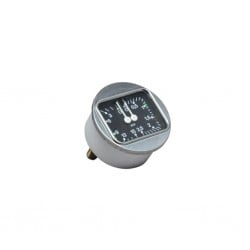
Not every pressure gauge is round. Some machines use rectangular or otherwise shaped instruments. For these gauges, compare the complete front width and height, body dimensions and mounting arrangement rather than trying to convert the dimensions into a nominal diameter.
Direct pressure connections and capillary gauges
Espresso machine pressure gauges can connect directly to a fitting or receive pressure through a copper capillary tube. Determine which arrangement the original machine uses before selecting a replacement.
Direct threaded connection
With a direct connection, the pressure gauge has its hydraulic fitting on the gauge body itself. Check the position of the connection as well as the complete thread specification.
Integrated capillary connection
Other gauges have a copper capillary permanently attached to the back of the instrument. In that case, compare not only the gauge itself but also the capillary routing, length where specified and the fitting at the hydraulic end.
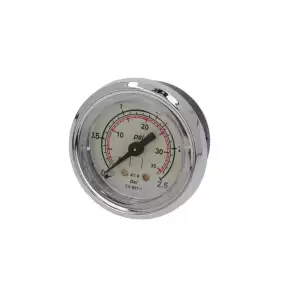
For example, the Vibiemme 0–16 bar pressure gauge with capillary has a 40 mm gauge body, a 47 mm front frame and an attached copper tube ending in a female 1/8" BSP-G connection. Brooks reference: 49-158-L-1245072; Vibiemme reference: MANMDOE40016.
A direct 0–16 bar gauge is therefore not automatically interchangeable with a 0–16 bar gauge supplied with an integrated capillary.
Separate pressure-gauge capillaries
Some machines use a separate capillary between the pressure gauge and the hydraulic circuit. When replacing such a line, compare:
capillary length → tube outside/inside diameter where specified → connection 1 → connection 2 → thread standard → thread size → male/female → sealing geometry
For generic pressure lines and other machine pipework, see copper tubing for espresso machines.
Pressure gauge threads: identify the complete connection
A description such as “1/8 inch connection” is not sufficient to confirm compatibility. For each pressure connection identify:
- thread standard;
- nominal thread size;
- male or female connection;
- sealing geometry;
- whether the connection is directly on the gauge or at the end of a capillary.
BSP-G is a parallel pipe-thread standard. Its nominal size is not the same as the outside diameter you measure across the male thread. Do not identify a BSP-G connection by measured diameter alone.
Some gauges and capillary systems use a different sealing geometry even where the nominal connection size appears similar. A matching thread size therefore does not automatically mean that two connections seal in the same way.
If adapters or replacement connections are required, compare them in the espresso machine fittings category using thread standard, nominal size, gender and sealing geometry.
Follow the original sealing method
Do not automatically add PTFE tape or another thread sealant to every pressure-gauge connection. First determine how the original connection is designed to seal. Depending on the fitting, sealing can occur at a dedicated seat or sealing surface rather than through the thread itself.
Use the original machine construction, OEM documentation and the specification of the replacement component as the reference.
Examples of different pressure-gauge configurations
The following examples show why several specifications must be combined:
- 0–16 bar pump gauge → single pump circuit → 39 mm body / 44 mm frame → male 1/8" BSP-G → Bezzera and ECM applications → Brooks 17-048-L-5062106
- 0–2.5 + 0–16 bar → dual boiler/pump gauge → 63 mm body / 70 mm frame → male 1/8" BSP-G connections → Astoria, Grimac and Wega applications → Brooks 49-187-L-1245411
- 0–16 bar pump gauge → integrated copper capillary → 40 mm body / 47 mm frame → female 1/8" BSP-G at capillary end → Vibiemme application → Brooks 49-158-L-1245072
These gauges overlap in individual specifications, but they are not interchangeable simply because they share a pressure range, thread size or similar appearance.
OEM and compatible pressure gauges
An OEM/original pressure gauge is supplied under, or directly corresponds to, the original machine manufacturer's part reference. A compatible pressure gauge is produced as an alternative for the same application.
Compatible does not mean universal, and it does not mean that every technical detail can be ignored. Compare the OEM reference, measured circuit, pressure range, dimensions, connection method, thread specification and listed machine application.
If both OEM and compatible versions are available, use the machine application and technical specifications to determine which replacement is suitable.
Shared applications across espresso machine brands
Pressure gauges can legitimately be used by several espresso machine manufacturers. Manufacturers may use gauges with the same technical specification from a common component supplier, or the same replacement can correspond to multiple OEM references.
Cross-brand compatibility is therefore not automatically a data error. The important point is that the relevant OEM references and technical specifications correspond to the stated applications.
The dual 0–2.5/0–16 bar gauge above is one example: the same technical component is listed for machines from Astoria, Grimac and Wega.
Do not identify a pressure gauge from appearance alone
Pressure gauges with similar chrome bezels and dial layouts can have different hydraulic connections, dimensions or pressure ranges. Use photographs only as a secondary visual check.
Where possible, combine:
- machine manufacturer;
- exact model and version;
- OEM reference;
- boiler, pump or dual function;
- pressure range for each circuit;
- body diameter or body dimensions;
- bezel/frame diameter or front dimensions;
- connection position;
- direct or capillary connection;
- thread standard and nominal size;
- male/female configuration;
- sealing geometry;
- listed machine compatibility.
Related pressure-system parts
A pressure gauge only displays pressure; other components generate or regulate it. Depending on the repair, related categories may also be relevant.
Use pressure switches for pressure-controlled boiler switching components, pumps and motors for pump-system components, fittings for hydraulic connections and adapters, and copper tubing for suitable machine pipework and pressure lines.
Availability
Availability and lead time vary by pressure gauge, manufacturer and machine application. Use the individual product page for the current product status rather than assuming one general delivery time for the complete category.